Part 5 of Paul’s Story…
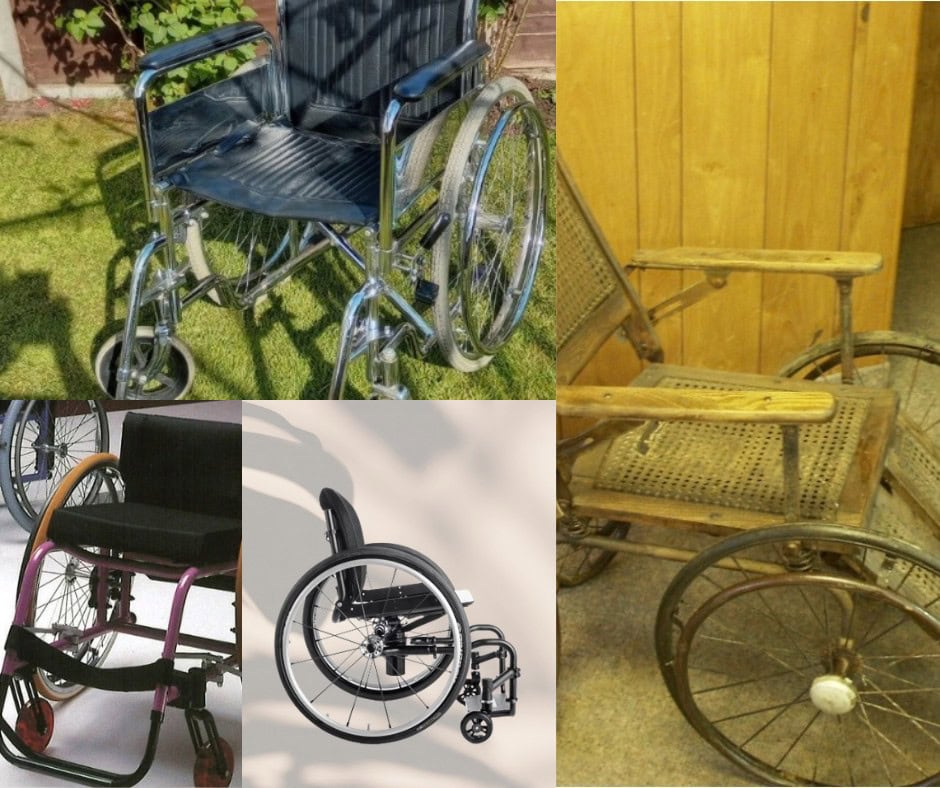
The advancement of the manual wheelchair has been remarkable over a relatively short period of time. Having used manual wheelchairs for more than four decades, I have been fortunate not only to witness this evolution but to experience it first-hand. Looking back over the past 45 years, the changes in materials, design and adjustability have been extraordinary.
A Brief History of the Manual Wheelchair
In 1783, John Dawson invented the Bath Chair, named after the town of Bath, England. You can see an example of a historic Bath Chair in the Science Museum Group Collection.
It featured two large wheels and one small wheel and became the most widely used wheelchair throughout the 19th century. During the Industrial Revolution, many improvements were made to wheelchair design. The Bath Chair was often uncomfortable, so manufacturers introduced features that enhanced comfort and durability. These developments included stronger metal frames and rubber tyres, creating designs that more closely resembled modern wheelchairs.
Then, in 1932, engineer Harry Jennings designed the first folding wheelchair for his friend, Herbert Everest, who had a disability. In 1933, the two founded Everest & Jennings, a company that pioneered innovations in wheelchair design, making wheelchairs lighter, more practical and easier to transport. Almost five decades later, an Everest & Jennings wheelchair would become part of my own story.
A New Era of Innovation
For me, the real transformation came with the development of lightweight, rigid-frame wheelchairs. The Quickie GP I eventually purchased marked the beginning of a new era of lightweight, high-performance wheelchairs that would go on to transform the lives of countless wheelchair users. Over the decades, I have owned many of the top-end rigid-frame manual wheelchairs from the leading manufacturers. Advances in materials such as aluminium, titanium and carbon fibre, together with the development of open-frame rigid designs, have dramatically reduced the overall weight of manual wheelchairs.
Even the wheels themselves have been redesigned to save weight while improving strength, efficiency and performance.
One wheelchair that stands out in my memory is the ICON A1 Suspension.
We had great fun with that model because, for several years, we were the sole UK distributor. At the time, it was probably one of the most adjustable manual wheelchairs available. Almost every aspect of the chair could be fine-tuned to suit the individual user and, unusually for a rigid-frame wheelchair, it also incorporated a suspension system to improve comfort and handling over uneven ground.
The promotional video for the ICON A1 demonstrated its remarkable adjustability in a fun, almost “Meccano-style” animation. The accompanying soundtrack, “King of the Bongo” by Mano Negra, was so memorable that the tune has stayed with me ever since. I even came close to making it the ringtone on my mobile phone.
For anyone interested in seeing just how innovative the chair was, the original promotional video perfectly captures the excitement surrounding its launch.
ICON A1 Promotional Video
There is also a second video showing the extensive adjustment features without the music, allowing you to appreciate just how adaptable the ICON A1 really was.
ICON A1 Adjustment Demonstration
Looking to the Future
The pace of wheelchair design over such a relatively short period has been nothing short of remarkable. Looking back over the past four and a half decades, I have witnessed a transformation that few could have imagined – from heavy, chrome-plated hospital wheelchairs to today’s lightweight, highly adjustable machines made from advanced alloys and carbon fibre.
As I reflect on that journey, I cannot help but wonder where wheelchair design will go next. Will artificial intelligence, robotics, smart materials and even exoskeleton technology redefine what we think of as a wheelchair? If the innovations of the last 45 years are anything to go by, the future promises to be every bit as exciting as the past.
For me, it has been an extraordinary ride. I have been fortunate not only to witness this evolution but to experience it first-hand. Each new chair represented another step towards greater freedom, independence and opportunity.
What a ride the past four and a half decades have been and I have a feeling the journey is far from over…